
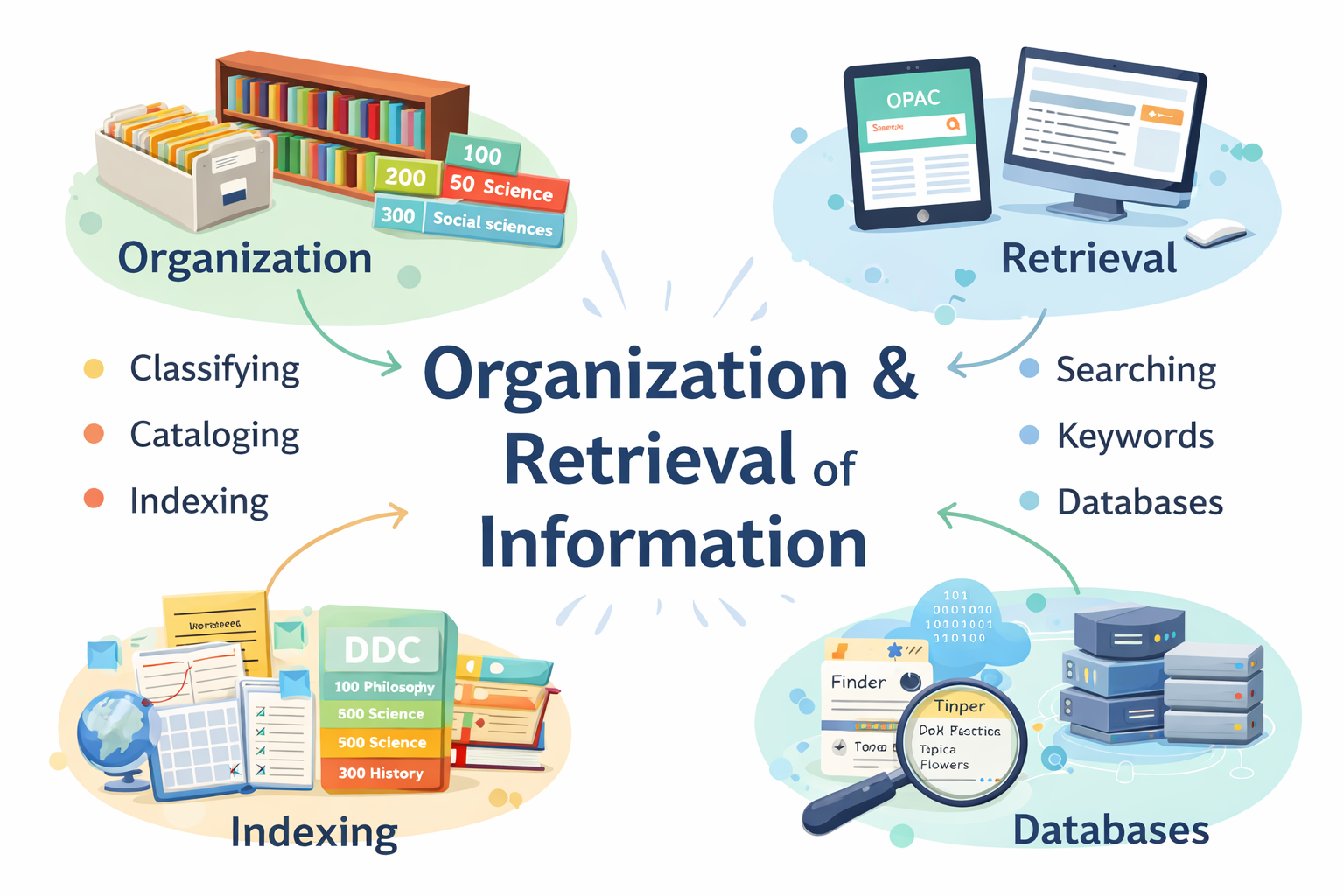
📚 Course Summary: Organization and Retrieval of Information
1. Introduction
This course focuses on how information is organized, stored, and accessed efficiently in libraries, databases, and digital systems. It ensures that users can find relevant information quickly and accurately.
2. Organization of Information
This involves arranging information resources in a systematic way for easy access.
Key Concepts:
- Cataloguing
Describing information materials (books, journals, etc.) using standard rules. - Classification
Grouping materials based on subject using systems like:- Dewey Decimal Classification (DDC)
- Library of Congress Classification (LCC)
- Metadata
Data about data (e.g., author, title, subject) - Indexing and Abstracting
Summarizing and assigning keywords to documents
3. Information Retrieval (IR)
This refers to the process of searching for and obtaining relevant information from a collection or database.
Components:
- User Query – what the user is searching for
- Search System – database or catalog
- Matching Process – comparing query with stored data
- Results (Output) – relevant documents retrieved
4. Information Retrieval Systems
Systems designed to help users locate information efficiently.
Examples:
- OPAC (Online Public Access Catalogue)
- Digital libraries
- Search engines like Google
5. Indexing and Search Techniques
- Keyword searching
- Boolean operators (AND, OR, NOT)
- Controlled vocabulary
- Subject headings (e.g., Library of Congress Subject Headings)
6. Evaluation of Information Retrieval
Measures how effective a system is:
- Precision – relevance of retrieved results
- Recall – completeness of retrieved results
7. Digital Information and Modern Trends
- Digital libraries and repositories
- Automation in libraries
- Use of AI in search and retrieval
- Online databases and e-resources
8. Importance of the Course
- Enhances efficient information access
- Supports research and learning
- Improves library services
- Helps manage large volumes of information.
- Teacher: Cecilia Kiptarus